
C/O Neighbour
A design concept for a mobile app that encourages a sharing community
Own Project
Research
UX
UI
Mobil Design
Goal:
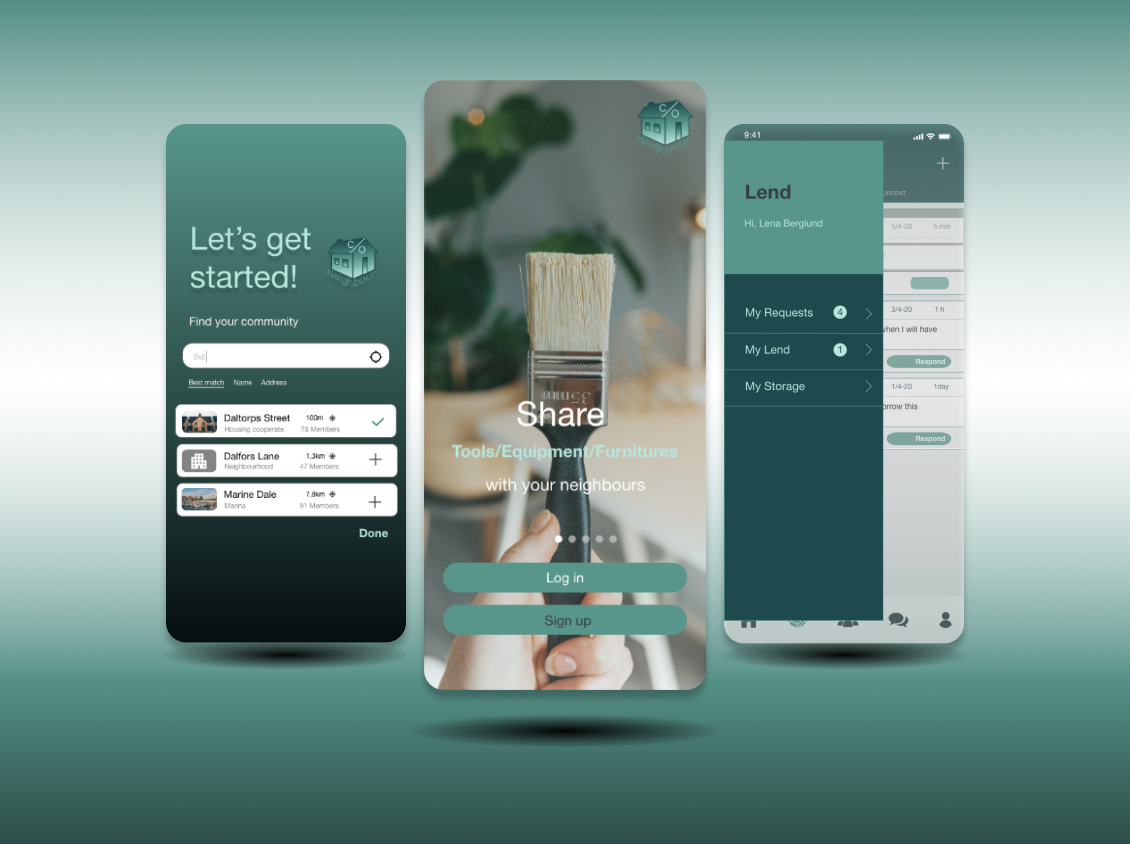
The goal was to explore and design a mobile app concept that enables neighbors to connect and support one another by sharing information and everyday items. The long-term ambition was to encourage more sustainable, community-driven behavior at a local level.
Outcome:
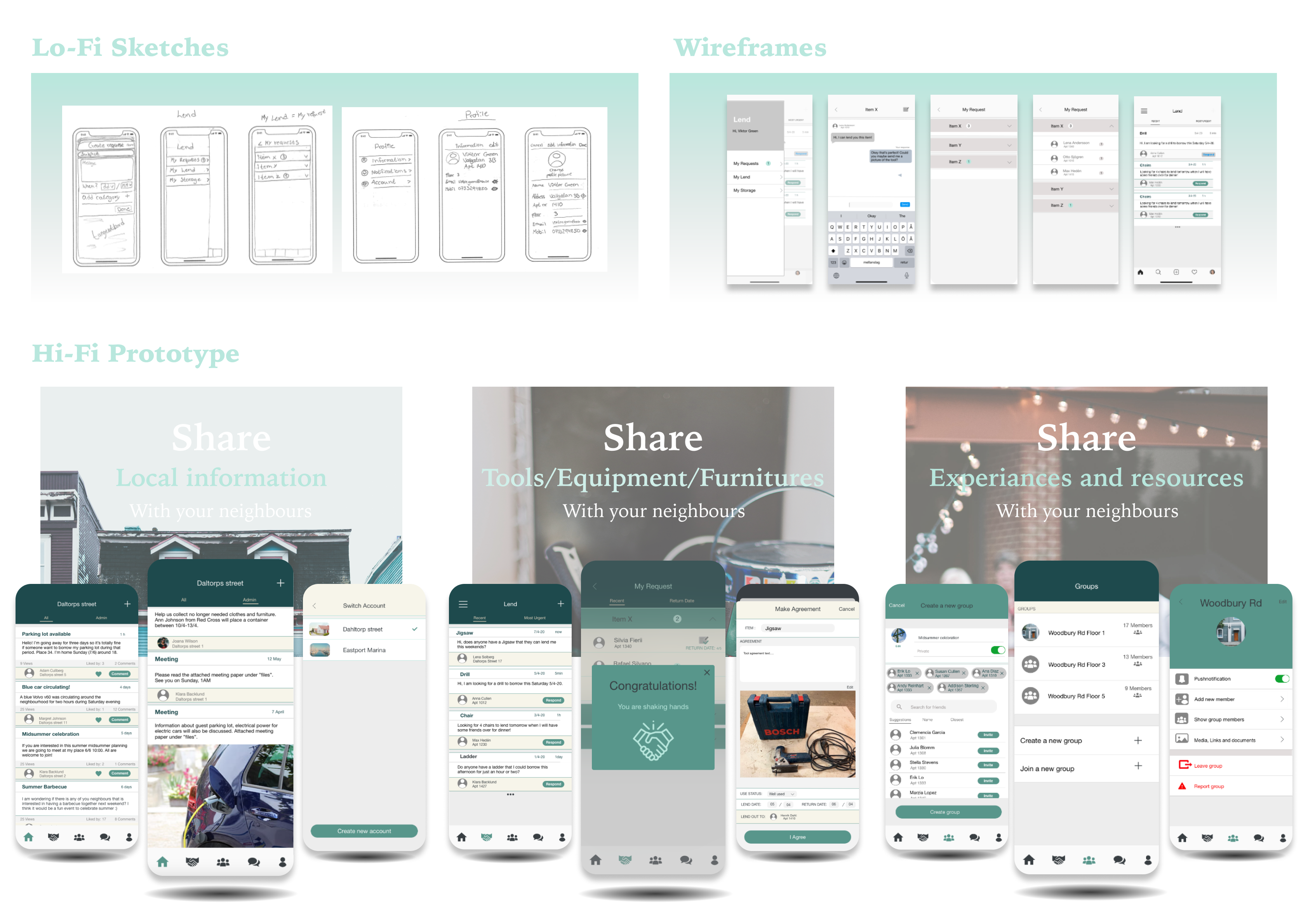
A concept for a future mobile application that could be used by users in thier Clickable interactive prototype made with Adobe X
My Role
I collaborated closely with another UX designer to identify a real user need and translate it into a viable digital solution. I contributed across the full design lifecycle, applying user-centered design methodologies and iterating based on research insights and feedback.
Tool & Process
- Adobe Xd: UI design and interactive prototyping.
- Process: Human-centered, iterative design process following the phases:Empathize, Define, Ideate, Prototype, Validate.
- Pen and Paper: Lo-Fi sketches
Overview
This project was completed as part of an individual course assignment, conducted in a team of two. Through initial exploration, we identified that many people lack a convenient way to connect with their neighbors, particularly in apartment buildings, where residents often do not know one another. Information sharing is still commonly handled through low-tech solutions such as handwritten notes posted at building entrances.
In parallel, we observed that people tend to own many items that are rarely used, often only a few times per year. This pattern contributes to unnecessary consumption and wasted resources. We identified an opportunity to support more sustainable, community-driven behavior by enabling neighbors to share information and everyday items in a simple and trustworthy way.
Key Design Challenges
- Create a simple and userfriendly solution that can be understood and used by veryday pople. userf
- Designing a collaborative environment optimised for sharing work and resolving conflicts between multiple users.
- Introducing robot programming software to the web while maintaining continuity with the existing desktop software ecosystem.
- Adapting a complex, feature-rich application interface to remain usable and accessible across devices.
- Translating well-proven concepts from the software development domain (such as version control and collaboration) to the specific context of offline robot simulation.
Design
Design Process
Empathize
Define the problem
User Interviews
Reserach Surveys
Market research
Define
User persona
User stories
Customer journey map
Ideate
User flow
Information architecture
Lo-Fi sketches
Validate
User testing
Prototype
Hi-Fi Mockups
Clickable prototype
Our app should be the first place the user shall visit to search for a tool/furniture to borrow before trying to rent it elsewhere. A typical product that could be listed in the app should be worth less than 1000 SEK take no more than five minutes walking to pick up, and have 24 hours lending period.


Curious to see more?
Explore the full case study on my Behance page, including the design process and final interactive prototype.
Go to Behanced


C/O Neighbour
A design concept for a mobile app that encourages a sharing community
Own Project
Research
UX
UI
Mobil Design
Goal:
The goal was to explore and design a mobile app concept that enables neighbors to connect and support one another by sharing information and everyday items. The long-term ambition was to encourage more sustainable, community-driven behavior at a local level.
Outcome:
A concept for a future mobile application that could be used by users in thier Clickable interactive prototype made with Adobe X
My Role
I collaborated closely with another UX designer to identify a real user need and translate it into a viable digital solution. I contributed across the full design lifecycle, applying user-centered design methodologies and iterating based on research insights and feedback.
Tool & Process
- Adobe Xd: UI design and interactive prototyping.
- Process: Human-centered, iterative design process following the phases:Empathize, Define, Ideate, Prototype, Validate.
- Pen and Paper: Lo-Fi sketches
Overview
This project was completed as part of an individual course assignment, conducted in a team of two. Through initial exploration, we identified that many people lack a convenient way to connect with their neighbors, particularly in apartment buildings, where residents often do not know one another. Information sharing is still commonly handled through low-tech solutions such as handwritten notes posted at building entrances.
In parallel, we observed that people tend to own many items that are rarely used, often only a few times per year. This pattern contributes to unnecessary consumption and wasted resources. We identified an opportunity to support more sustainable, community-driven behavior by enabling neighbors to share information and everyday items in a simple and trustworthy way.
Key Design Challenges
- Create a simple and userfriendly solution that can be understood and used by veryday pople. userf
- Designing a collaborative environment optimised for sharing work and resolving conflicts between multiple users.
- Introducing robot programming software to the web while maintaining continuity with the existing desktop software ecosystem.
- Adapting a complex, feature-rich application interface to remain usable and accessible across devices.
- Translating well-proven concepts from the software development domain (such as version control and collaboration) to the specific context of offline robot simulation.
Design
Design Process
Empathize
Define the problem
User Interviews
Reserach Surveys
Market research
Define
User persona
User stories
Customer journey map
Ideate
User flow
Information architecture
Lo-Fi sketches
Validate
User testing
Prototype
Hi-Fi Mockups
Clickable prototype
Our app should be the first place the user shall visit to search for a tool/furniture to borrow before trying to rent it elsewhere. A typical product that could be listed in the app should be worth less than 1000 SEK take no more than five minutes walking to pick up, and have 24 hours lending period.
Curious to see more?
Explore the full case study on my Behance page, including the design process and final interactive prototype.
Go to Behanced
C/O Neighbour
A design concept for a mobile app that encourages a sharing community
Own Project
Research
UX
UI
Mobil Design
Goal:
The goal was to explore and design a mobile app concept that enables neighbors to connect and support one another by sharing information and everyday items. The long-term ambition was to encourage more sustainable, community-driven behavior at a local level.
Outcome:
A concept for a future mobile application that motivates people to share knowledge, tools, and furniture within their neighborhood and local community. The concept was visualized through a high-fidelity, clickable interactive prototype created in Adobe XD.
My Role
I collaborated closely with another UX designer to identify a real user need and translate it into a viable digital solution. I contributed across the full design lifecycle, applying user-centered design methodologies and iterating based on research insights and feedback.
Tool & Process
- Adobe Xd: UI design and interactive prototyping.
- Google Forms: User research survey
- Pen and Paper: Lo-Fi sketches
- Process: Human-centered, iterative design process following the phases:Empathize, Define, Ideate, Prototype, Validate.
Overview
This project was completed as part of an individual course assignment, conducted in a team of two. Through initial exploration, we identified that many people lack a convenient way to connect with their neighbors, particularly in apartment buildings, where residents often do not know one another. Information sharing is still commonly handled through low-tech solutions such as handwritten notes posted at building entrances.
In parallel, we observed that people tend to own many items that are rarely used, often only a few times per year. This pattern contributes to unnecessary consumption and wasted resources. We identified an opportunity to support more sustainable, community-driven behavior by enabling neighbors to share information and everyday items in a simple and trustworthy way.
Key Design Challenges
- Simplicity and accessibility: Designing a solution that is intuitive and easy to understand for everyday users, regardless of technical proficiency.
- Trust and safety: Designing mechanisms that build confidence and a sense of safety when sharing personal items within a local community.
Design
Design Process
Empathize
Define the problem
User Interviews
User research survey
Market research
Define
User persona
User stories
Customer journey map
Ideate
User flow
Information architecture
Lo-Fi sketches
Prototype
Hi-Fi Mockups
Clickable prototype
Validate
User testing
Our app should be the first place the user shall visit to search for a tool/furniture to borrow before trying to rent it elsewhere. A typical product that could be listed in the app should be worth less than 1000 SEK take no more than five minutes walking to pick up, and have 24 hours lending period.
Curious to see more?
Explore the full case study on my Behance page, including the design process and final interactive prototype.
Go to Behanced